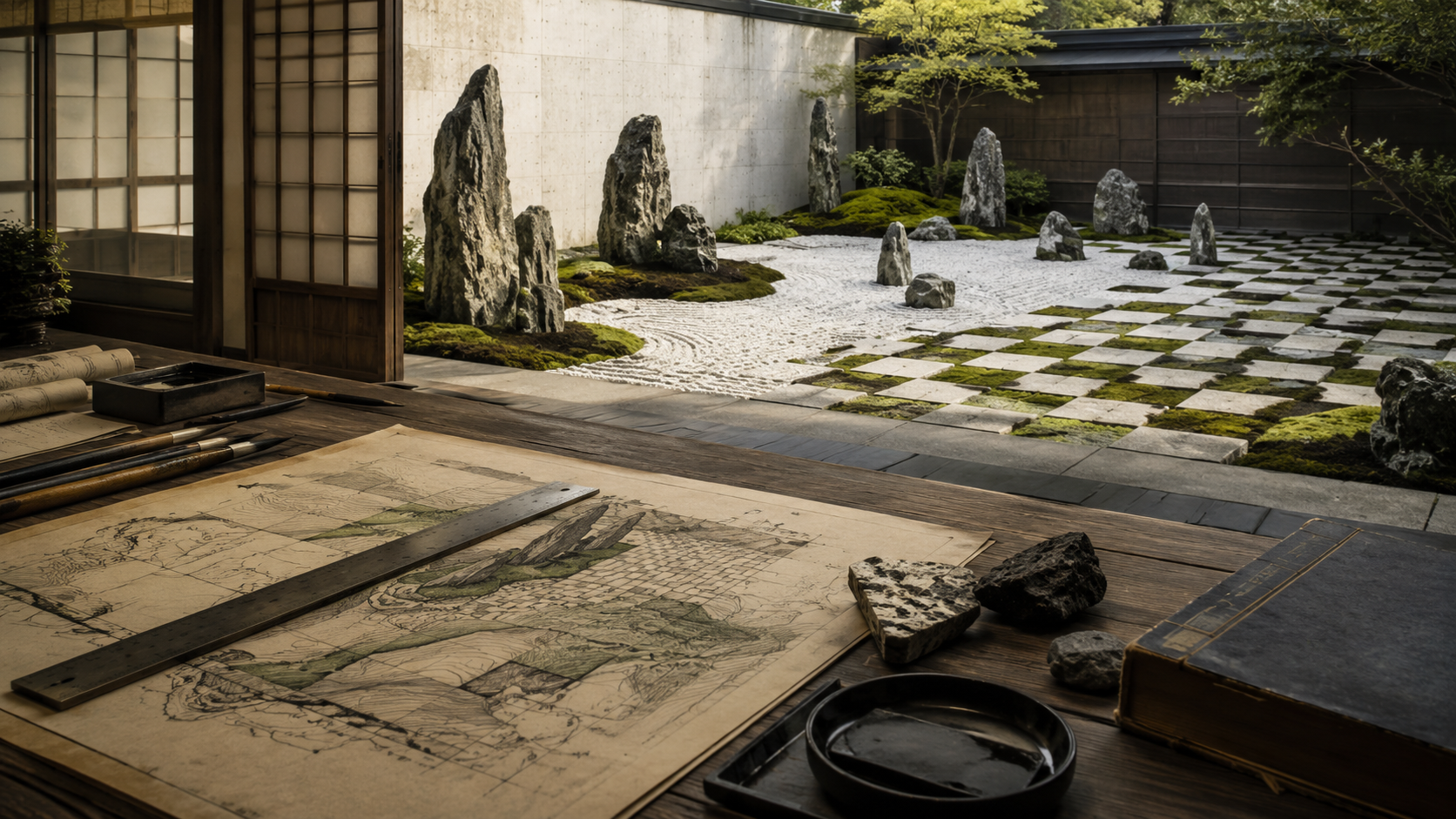
The deeper you look into a tradition, the more likely you are to feel in awe of it. You see how much earlier generations achieved, and it becomes harder to bring yourself to change anything.
Mirei Shigemori went the other way.
He took the measure of much of the Japanese garden’s past himself. The more he learned, the less inclined he was to copy what he found. The surveys drew him deep into the past and ultimately made him one of the most avant-garde designers in the history of the Japanese garden.
I have worked with his grandson, Chisao Shigemori, on several occasions. Those experiences made me want to understand how the family thinks about making gardens. Spend enough time with Chisao’s work and sooner or later you find yourself looking back to his grandfather.
If I had to name the five or six greatest garden makers in a thousand years of Japanese garden history, Mirei Shigemori would be among them.
He was both a garden historian and a garden maker. What made him unusual was how closely those roles came together. For him, research and making gardens were almost the same activity.
He returned to the same questions throughout his life. Where did this tradition come from? How did it come to look the way it does? What can still grow out of it today?
From Japanese Painting to Gardens
Mirei Shigemori was born in Okayama Prefecture in 1896. He studied flower arrangement and tea as a young man, then trained in Japanese painting at the Japan Art School. He continued to study architecture, gardens, and other traditional arts.
His formal training was in Japanese painting, but his interests went beyond its established forms. He followed modern Western art and design and considered how line, color, abstraction, and composition could open up new ways of making art.
Painting, flower arrangement, and tea all require a sense of composition, proportion, and empty space.
The angle of a single stem, the lines that lead the eye, the distance between elements, and the spaces left empty can change the feeling of the whole work.
That training gave Shigemori a different way of looking at a garden from someone who approached it primarily through horticulture.
Stone, white sand, moss, trees, and water were natural materials. They could also convey line, mass, rhythm, and ideas.
A garden could be a work of art.
That conviction stayed with him. His gardens often have striking geometries, compositions that verge on abstraction, and stone arrangements with tremendous presence. They look modern and draw on centuries of Japanese garden making.
An artist’s eye alone hardly explains why he undertook a survey on such a scale.
A typhoon changed his course.
A Typhoon and the Decision to Record the Gardens
In 1934, the Muroto Typhoon struck the Kyoto, Osaka, and Kobe region. Trees, buildings, and grounds at Katsura Imperial Villa and many of Kyoto’s best-known gardens suffered severe damage.
A painting can be taken into a museum. A garden remains exposed to the weather and the passing years.
Trees grow and age. Water takes a different course. Buildings may collapse. Storm damage, rebuilding, or even a change in maintenance can gradually change a garden’s appearance.
Sometimes a garden disappears quite suddenly.
A scene formed over centuries can be swept away overnight. Many important gardens still had no sufficiently precise plans or records at the time. Once a garden was damaged, it could be hard to know how it had been laid out.
After the typhoon, Shigemori decided to record the old gardens one by one while they were still there.
From 1936 to 1938, he undertook a large survey of historic Japanese gardens.
Visiting and taking photographs was only a beginning. He measured the terrain, located stone groups, trees, waterways, and buildings, and drew plans and elevations. He photographed the sites, sketched details, and looked into each garden’s history and the records that had survived.
Looking lets you take in a garden. Measuring makes you learn its composition inch by inch.
He had to check the angle of each stone, the distances between them, the rise and fall of the ground, the course of the water, and the lines of sight through the garden.
Travel and camera equipment before the war made the work especially demanding. Even today, with trains and trams, visiting several gardens in a day can be tiring. When Shigemori arrived, he still had to measure, draw, photograph, and check the historical evidence.
The work took knowledge, stamina, patience, and remarkable persistence.
In three years he documented roughly 350 gardens. Those surveys formed the basis of the 26-volume Nihon Teienshi Zukan (日本庭園史図鑑, an illustrated history of Japanese gardens). Its measured drawings, photographs, sketches, and historical records remain a foundation for the study of Japanese garden history.
Late in life, he and his eldest son, Kanto Shigemori, surveyed gardens again, reorganized the earlier material, and expanded it into the 35-volume Nihon Teienshi Taikei (日本庭園史大系, a comprehensive history of Japanese gardens).
Together the two sets amount to something close to an encyclopedia. They establish dates, trace the history and layout of individual gardens, and preserve drawings, photographs, sketches, chronologies, and documents.
I later had a chance to leaf through the Nihon Teienshi Taikei. Even a single volume was surprisingly thick and heavy. Inside, the history, composition, and interpretation of each garden were given in great detail. The drawings showed precisely where an individual tree, stone, or watercourse lay.
It was a history written on foot, measured with a ruler, and drawn line by line.
Many of those gardens have since changed. Trees, waterways, and the land around them may look quite different today. Shigemori’s drawings are valuable to researchers and preserve the way each garden looked at a particular moment.
The surveys did more than leave a record. Measuring one garden after another led Shigemori to ask why earlier garden makers had arranged things as they did.
The More He Studied, the Less He Wanted to Copy
When you look at a garden, what stays with you first is often the overall impression.
Measuring it forces you to look again. Why does this stone stand here? Why does it face that way? How does it relate to the stone beside it? Why does the water pass through here? Why does a visitor stop at one particular spot?
Shigemori measured distances, terrain, and positions. What he was studying was composition.
After years of looking at stone arrangements, he came to see them as the principal framework of the Japanese garden.
The angle at which a stone stands, the direction of its face, how deeply it is set in the ground, and the space between it and the next stone all affect the presence of the garden as a whole.
Some stones stand tall, some lean forward, and others lie low against the earth. Some suggest mountains, islands, or waterfalls. Others stand for nothing in particular and make a composition through their weight, direction, and posture.
Trees change over the years. Stone arrangements give the garden its underlying structure, set the rhythm of the space, and guide the eye.
In his writings, Shigemori placed stone arrangement at the heart of Japanese garden making. The maker first had to find a stone’s most beautiful posture. Only when the maker and the stone seemed to breathe together could the work begin.
As he surveyed one garden after another, he saw more than the skill of the people who had made them.
He began to see that the finest old gardens had gone beyond the formulas available to their makers.
They inherited religious ideas, ways of organizing space, and a vocabulary of garden forms. The leading garden makers of each period took those inheritances and rearranged the relationships among stone, water, plants, and buildings to suit the culture, techniques, and sites of their own time.
Many gardens that look thoroughly classical today were new in their day.
The more deeply Shigemori studied, the harder it was for him to equate fidelity to tradition with reproducing its forms.
Repeating an old garden’s outward appearance is no guarantee of doing it justice. What deserves to be passed down is the willingness their makers showed to try forms that were new in their own time.
The more deeply he studied, the less he wanted to copy. He saw that the works that had changed Japanese garden history had all gone beyond the answers they inherited.
That knowledge gave him room to make his own judgments.
He knew which forms belonged to a particular era, which stone arrangements carried specific religious meanings, and which compositions could still be rearranged.
The right to rewrite a tradition has to be earned.
Shigemori earned it with a ruler, one garden at a time.
Another Way a Garden Can Disappear
The Muroto Typhoon showed Shigemori that weather and time could take a garden away.
His surveys showed him a quieter kind of disappearance.
Over time, more gardens took up established forms. Stone arrangements, spatial layouts, dry landscapes, and symbols inherited from earlier makers settled into techniques that could be used again and again.
The workmanship could still be refined and the gardens beautiful. Yet with each repetition, something of their creative force could wear away.
A garden might keep its outward form even after it had lost the power it once had to stop a visitor short.
A typhoon can destroy the physical garden. Imitation can wear away a tradition’s capacity to create.
That was one reason the study of old gardens made Shigemori less inclined to revive old styles.
He wanted to preserve the history of the Japanese garden and keep it an art with something still ahead of it.
“Eternal Modern”
Shigemori used the phrase “Eternal Modern” for the beauty he was after.
“Modern” here has little to do with fashion. He meant a quality of invention that could keep its force long after its own moment had passed.
The makers of the finest classical gardens already knew how to rearrange, simplify, and abstract the forms of nature.
A garden need not reproduce a mountain or river as it appears in nature. With stone, sand, water, and plants, a garden maker can create an order that exists nowhere outside the garden.
Stone is still stone, and white sand is still white sand. Rearranged, they can become oceans, islands, constellations, battle formations, or a wholly abstract composition.
Making Japanese gardens look Western held no interest for him. Novelty for its own sake held little appeal either.
He wanted to recover the inventive energy that had been part of the tradition all along.
A living tradition keeps changing. The makers of each generation have to respond to new sites, new ways of living, and new ways of seeing. The answers have to be their own.
“Eternal Modern” described a commitment to keep inventing as times changed. It could take any number of forms.
Innovation Grounded in History
I have always loved Japanese gardens. Even after working with Japanese garden specialists several times, I am still struck by what they can see.
Sometimes one photograph is enough for them to make an educated guess about who designed a garden or which period it belongs to.
The posture of the stones, the layout of the ground, the placement of stepping stones, and the treatment of plants are like handwriting. They carry clues to the maker and the time.
It helped me understand why the garden historian Hiromasa Amasaki placed so much emphasis on Shigemori’s research when discussing him on Core Kyoto.
As I understood Amasaki’s point, the sheer number of historic gardens Shigemori had studied gave him an exceptionally solid grounding. His innovations held up because he understood the history and the tradition so well.
Making a form look different is easy enough.
The harder thing is to make a change that still has a clear connection to the past and feels as though it belongs exactly where and when it appeared.
Shigemori knew what he had inherited and what he was changing.
His work looks bold, but it rarely seems to have come out of thin air. Behind each breakthrough were the hundreds of gardens he had walked through, measured, and drawn.
At Tofukuji, the freedom he had earned through research first came into full view.
Tofukuji: What a Constraint Made Possible
In 1939, at the age of 43, Shigemori completed the Honbo Garden at Tofukuji in Kyoto.
It was his first major work after completing his nationwide survey and publishing the Nihon Teienshi Zukan.
He had just spent years looking at the answers offered by earlier Japanese gardens. At Tofukuji he offered one of his own.
The temple gave him one clear condition. All the materials already at the temple’s main quarters had to be kept and reused.
The request reflected a Zen reluctance to waste anything. A new design was no reason to treat the stone already on the site as useless.
That condition turned out to be central to the work.
Seven cylindrical foundation stones left over from repairs to the temple’s lavatory became the Big Dipper in the east garden. Square stones that had paved a temple path became the ichimatsu, or checkerboard, pattern in the north garden.
The shapes were plainly man-made. The cylinders could hardly pass for natural rocks, and there was no hiding the straight edges of the squares.
Shigemori accepted the shapes as he found them and gave them a new order.
The cylinders stayed cylindrical. The squares stayed square. Those visibly worked stones became the most modern part of the garden.
Early sketches kept by the Shigemori family do not yet show the famous checkerboard. The temple’s insistence on reusing the existing materials helped give those forms their shape.
He kept every old stone and made a garden unlike any that had come before.
The constraint gave him a concrete problem he had to solve.
What feels modern at Tofukuji grew directly out of the temple’s past, its Zen attitude toward material things, and what was already on the site.
At Tofukuji, the materials set the terms.
At Kishiwada Castle, the question was where people would stand to see the garden.
Kishiwada Castle: Designing the View
In 1953, Shigemori designed the Hachijin Garden, or Garden of Eight Battle Formations, at Kishiwada Castle in Osaka.
The design takes its theme from the eight battle formations associated with the Chinese strategist Zhuge Liang. A group of stones represents the commander at the center. Eight formations surround it, spread across three levels in a composition that opens outward in all directions.
At ground level, visitors can see the groups of standing stones from any side.
Each group has a direction, a weight, and a tension of its own. As you move around the garden, the relationships among the groups keep changing.
Climb the castle keep and the work takes on a different appearance.
From above, groups that had seemed separate form a single diagram of the eight formations. The standing stones you encountered group by group now come into focus as one composition with a center and a clear order.
Shigemori designed for the view from the keep and even considered what the garden would look like from the air.
Traditional Japanese gardens often work with horizontal sightlines, from a veranda or along a garden path. The Hachijin Garden adds a view from above.
From ground level you feel the force of the individual groups of stones. From above you see the whole battle formation.
The garden is the same. Move the viewpoint and its meaning changes.
Shigemori designed the garden and the ways people would see it.
At Tofukuji the constraint lay in the materials at hand. At Kishiwada Castle he rearranged the terms of viewing.
At Kanyoji, late in life, he faced a larger subject altogether: the whole history of the Japanese garden.
Kanyoji: The Historian and the Garden Maker
I am particularly fond of the gardens Shigemori completed late in his life at Kanyoji in Yamaguchi Prefecture.
He designed and directed the making of several gardens there. Among them are the Garden of the Winding Stream, the dry landscape garden Jizō Yūge no Niwa, and the Garden of Nine Mountains and Eight Seas, with its stone arrangements and pond.
Drawing water from Chōondō in the hillside behind the temple, he brought flowing water, ponds, and dry landscape gardens into the same grounds. The work took eight years. Kanyoji is one of the few places where the forms of several periods of Japanese garden history can be seen together.
Kanyoji is less familiar than Tofukuji, yet the world its gardens present feels remarkably complete.
Water runs between stones. Trees and distant mountains recede in layers behind them. Each part can be seen on its own, and water, terrain, and lines of sight draw the parts together.
From some angles the place seems almost otherworldly.
That effect comes from choices a garden maker made. Where each stone sits, where the water turns, how the trees form layers, and how much of the distant mountain enters the view have all been considered.
The materials of the place become a landscape painting you can walk into.
There is something more unusual about Kanyoji than its beauty.
The man who had traveled across Japan measuring gardens from many periods was now working with those historical forms himself, on the same temple grounds. He could draw on winding streams, pond gardens, dry landscapes, and stone arrangements all at once.
He made no museum of garden history there and reconstructed no garden from a particular period.
The forms he had studied became materials for new work.
The man who had recorded history with a ruler was now carrying it forward with stones, running water, and the shape of the land.
At Kanyoji, Shigemori the historian and Shigemori the garden maker are hard to tell apart.
When he surveyed old gardens, he looked at composition, distance, and the relationships among stones with a garden maker’s eye. When he made new gardens, he went on asking a historian’s questions.
What made these forms work? Centuries later, how might they still change?
Measuring was already a way of thinking about design. Designing kept him asking the same question that guided his research: what can still grow out of the Japanese garden today?
At Kanyoji, the eye looking back at history and the hand making its future were finally at work on the same thing.
Keeping the History of the Japanese Garden Alive
Understanding Mirei Shigemori changed the way I look at Chisao Shigemori’s work.
What has carried through the family is the understanding that the Japanese garden is still an art in which new work can be made. It runs deeper than a checkerboard pattern or a stone arrangement that can be repeated.
A garden can disappear in two ways. Mirei Shigemori had a different tool for each.
For one kind of loss, he used a ruler. Inch by inch he recorded gardens that typhoons, time, or rebuilding might take away.
For the other, he used stone. Where the old forms survived but repetition had worn away their creative force, he made gardens no one had seen before.
Research gave him more to do than guard the past. It showed him that what deserved preserving was the garden’s capacity for new work as much as its outward form.
He did not leave the Japanese garden in the past.
He helped it go on making history.