After the Gates Close, the Park Can Still Cool the City
If you live beside a park but rarely go in for a walk or exercise, what do you gain?

By ten o'clock at night, Shinjuku Gyoen in Tokyo had long since closed. (The garden charges admission and has set opening hours.)1
The visitors had left, but instruments were still recording changes in the park and the surrounding streets.
During a night of observations in the summer of 2000, researchers found that the wind at the park boundary turned outward at about ten o'clock, accompanied by a temperature drop of roughly 1°C. This 58.3-hectare park, with its woodland and lawns, was sending cooler air formed during the night into the surrounding neighborhood.
Measurements beyond the boundary traced that cooler air to a distance of about 80 to 90 meters. In the streets it reached, air temperatures were close to those inside the park, and 2 to 3°C lower than in the adjacent built-up area farther out.2
A study of 60 parks in Taipei also measured air temperatures both inside and outside the parks. It found that the cool islands of some parks extended into the surrounding streets. The horizontal movement of cooler air carried the influence of the green space beyond its boundary.3
The park had closed, but people living around it still benefited. Even on a day when they never entered, the green space could make the air near their homes cooler.
A Park Works Differently by Day and Night
During the day, tree canopies shield people and the ground from direct sunlight. Plants and moist soil also carry away some heat through evapotranspiration. Compared with land covered by roads, parking lots, roofs, and building walls, green space can store less heat by day, leaving less to be released into the streets after sunset.
The distribution of temperatures within a park also changes after dark.
At Shinjuku Gyoen, the cool-island effect was stronger in the wooded areas during the day. On clear nights with light winds, the open lawn lost heat to the sky through radiation. Air near the ground became cooler than the air beneath the tree canopy, supplying the cool air that flowed beyond the park.2
Woodland provides daytime shade, while open grassland helps release heat at night. Keeping different kinds of vegetation and space allows a park to perform different functions over the course of a day.
What Covers the Ground Matters
A large, continuous green space has more opportunity than scattered patches of greenery to create a microclimate distinct from the surrounding built-up area. Its tree canopy, soil, and paving directly affect how much cooling it can provide.
A Taipei study published in 2007 measured air temperatures in and around 61 parks. The parks were cooler than their surroundings on average, but about one in five was warmer. At midday in summer, parks with more than half their area paved and little shade from trees and shrubs were, on average, hotter than the surrounding streets.4
Large stone plazas, concrete paths, and parking areas absorb sunlight during the day, adding to a park's heat load. Tree shade, moisture retained in the soil, and plant evapotranspiration help reduce it. In hot, humid cities, planting also needs to leave space for air to move.5
The 2014 Taipei study therefore recommended that parks and open spaces used mainly during the day have less than 50 percent paved area and at least 30 percent coverage by trees, shrubs, and other shade.3 How much shade and permeable ground a park retains directly affects how people feel both inside it and nearby.
Measurements in Kaohsiung
A study published in 2021 used 16 air-temperature monitoring points across an area of roughly 7.5 × 6 kilometers in urban Kaohsiung to map temperatures during the hot season. The area around Kaohsiung Main Station was among the warmer zones, while Zhongdu Wetland Park and Shoushan were cooler. In the average temperature distribution for April through August, the warmer and cooler zones differed by about 2°C.6
When the Park's Climate Crosses the Street
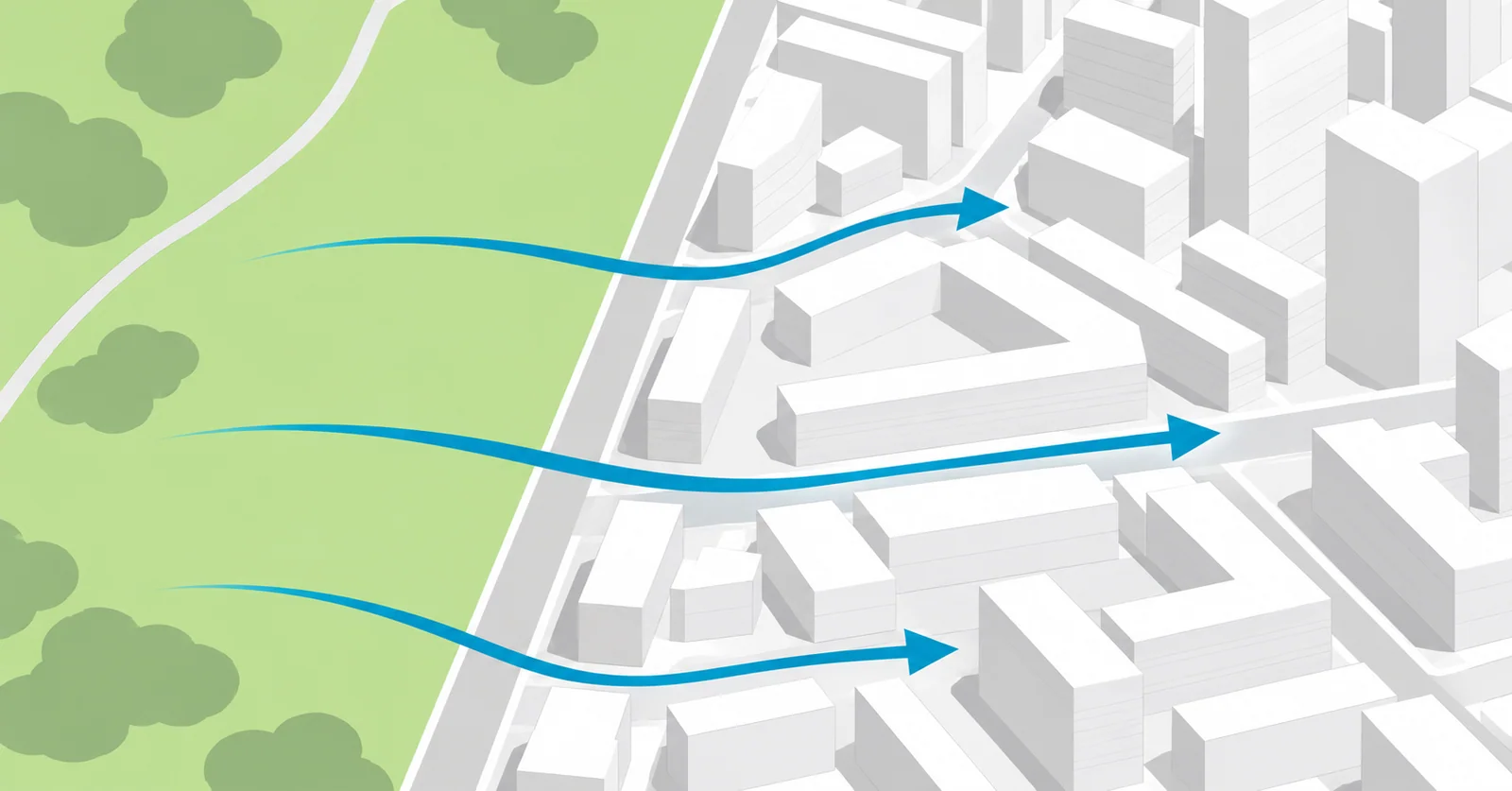
For the first row of homes facing a large green space, the easiest benefit to see is the view.
Less visible is what the open land leaves out: an entire stretch that might otherwise consist of roofs, walls, roads, and heat discharged by air conditioners. Instead, it retains tree canopy, vegetation, and soil. Homes along its edge also face fewer nearby building obstructions, giving them a better chance of receiving the air moving around the park.
Homes beside a school campus can be understood in the same way, by looking at what actually covers the land. A campus rich in trees, soil, and vegetation provides shade, evapotranspiration, and open space. One dominated by concrete playing fields and other paved surfaces mainly provides distance between buildings and an open outlook, while its paving continues to absorb heat in the sun.
After air leaves a green space, it needs streets and gaps between buildings through which it can keep moving. Professor Tzu-Ping Lin of National Cheng Kung University describes three linked approaches: more greenery and less air conditioning, room for wind to move, and shade for pedestrians. Making room for wind includes adjusting building orientation and increasing the gaps between buildings so that air from parks, rivers, and other open areas can enter the neighborhood.7
Between the park and the home, the arrangement of buildings and the gaps left between them influence how far the air can travel.
Air Needs a Path from the Window into the Home
Once air reaches a building's façade, the size and position of windows, the relationship between inlets and outlets, and interior partitions influence how far it can move inside.
With windows on only one side, much of the air exchange may occur near the windows. Partitions that interrupt the path can also limit ventilation deeper inside the home. Taiwan's Architecture and Building Research Institute studied an apartment complex in Fengshan, Kaohsiung, using wind-tunnel tests and simulations to examine how building spacing, wind direction, and opening arrangements affect outdoor airflow and indoor ventilation.8
Windows also need shade. Large windows facing a park can bring daylight and views; where they also receive strong western sun, balconies, overhangs, or other external shading can reduce solar heat gain and the indoor cooling load.7
Cooler air around a park, paths between buildings, and the home's windows, partitions, and shading together connect the green space to residents' everyday comfort.
You Can Benefit Even If You Rarely Go Inside
Walking, running, and playing are experiences gained by entering a park. People who rarely go inside may still enjoy the cooling it brings to the neighborhood.
When considering the value of living near a large green space, we can look beyond how often we will visit and ask one more question:
If this large green space were gone, how much hotter would this place become?
Sources and Notes
- Japan Ministry of the Environment, Shinjuku Gyoen visitor information. Admission fees and opening hours. Accessed November 9, 2026. ↩
- Narita, K. et al. (2004), “Cool-island and Cold Air-seeping Phenomena in an Urban Park, Shinjuku Gyoen, Tokyo”, Geographical Review of Japan 77(6), 403–420. Original paper PDF. Summer 2000 observations: the wind shift and temperature drop at the boundary are discussed on p.410; the 2–3°C difference between the area reached by cooler air outside the park and the adjacent built-up area is reported on p.411. ↩1 ↩2
- Chang, C.-R. & Li, M.-H. (2014), “Effects of urban parks on the local urban thermal environment”, Urban Forestry & Urban Greening 13(4), 672–681. Abstract in the authors' university repository. Air-temperature measurements inside and outside 60 Taipei parks, with recommendations on paving and shade for areas used during the day. ↩1 ↩2
- Chang, C.-R., Li, M.-H. & Chang, S.-D. (2007), “A preliminary study on the local cool-island intensity of Taipei city parks”, Landscape and Urban Planning 80(4), 386–395. Abstract in the authors' university repository. Air-temperature measurements at 61 parks; about one fifth were warmer than their surroundings. The study also analyzed paving and tree and shrub coverage. ↩
- Norouzi, M., Chau, H.-W. & Jamei, E. (2024), “Design and Site-Related Factors Impacting the Cooling Performance of Urban Parks in Different Climate Zones: A Systematic Review”, Land 13(12), 2175. Discussion of planting arrangements, ventilation, and hot, humid climates. ↩
- Chao, C.-C. et al. (2021), “Application of a High-Density Temperature Measurement System for the Management of the Kaohsiung House Project”, Sustainability 13(2), 960. The study used 16 urban monitoring points. See §3.3, Figure 8, and the conclusions for the hot-season average temperature distribution and the difference between warmer and cooler zones. ↩
- Taiwan Ministry of Science and Technology (2020), “多綠少空調、讓路給風走、遮蔭供人行” [More Greenery and Less Air Conditioning; Room for Wind; Shade for Pedestrians]. An account of Professor Tzu-Ping Lin's team's research on urban cooling, ventilation, and shade. The bracketed title is a descriptive translation. ↩1 ↩2
- Taiwan Architecture and Building Research Institute (2018), “集合住宅配置方式對戶外風場與室內通風之影響” [Effects of Apartment Building Layout on Outdoor Airflow and Indoor Ventilation], Building Research Newsletter, no.101. Wind-tunnel tests and indoor ventilation simulations for an apartment complex in Fengshan, Kaohsiung. The bracketed title is a descriptive translation. ↩